Wednesday, December 16, 2020

Creating Legacy Through SIP

You all invest in mutual funds for wealth creation over a period of time or to achieve your personal goals. But, how many of you really invest through MF to create a legacy for your third-generation, not even 1%. Forget about the third generation, most even don't plan for their second-generation via MF mode. You might be running a business and having succession planning to handover it to your next generation and also might be asset holding like gold, real estate, or FD to pass on but not MF or Equity. 

MF (equity & Hybrid), despite having the highest potential to generate a return in long term, the investor just holds on an average 3 - 5 years max and therefore fails to get real fruits from compounding benefits. You all know equity is a volatile asset and recommended for the long term so as MF SIP. The returns are not guaranteed in gold or real estate either, even then people hold it for years & years. However, in the case of MF, people seek guarantee & returns in short term, which altogether the wrong approach to look at this wonderful asset class. MF is the only vehicle that provides you facility from savings to investing. In the short term, safety is more important and in long term looks for the returns and therefore change asset class category within the MF accordingly.

How many of you plan to receive 10 crores or 100 crores through SIP mode. I bet, none; the reason being SIP holding period on an average is just 3 years in 90% of the cases. And when you talk about 40 to 60 years SIP, nobody interested to create that legacy after so many years. Everyone wants quick money overnight basis and even today equity investment is considered as an immediate profit mode. It doesn't matter whether you invest 10,000 or 20,000 p.m., more important is the longer time period which is an essential part of compounding growth and set you to become financially independent. 

A million-dollar question is who is interested to sacrifice one generation for the next generation? Is it a matter of investing 10k or 20k for 40 - 60 years, not really? It's a matter of long patience, conviction, and behavioral finance. Unfortunately, everyone wants to be financially free but nobody wants to act in that direction to achieve that!


Disclaimer: Mutual Funds investment are subject to Market Risk

Monday, December 14, 2020

Market Return vs Investor Return

We all know Equity has the potential to provide the highest return followed by Real Estate. However, it is also observed that 90% of investors do not get much benefit as compared with other asset classes for example Real Estate, Gold, Insurance, Bonds, etc.

There are mainly 3 reasons for getting poor returns from Equity.

  • Behaviour Finance: 
  • Investor perception changes when investing in Equity vs other asset classes. Investors remain invested in other asset classes even if they make losses in the short to medium term, but in the case of equity, they exit in panic. For example, they will never exit from Gold or Real Estate in loss even if they have to hold for 10 - 20 years and they hold it without losing their patience. On the other hand, Equity is a unique asset class where people are more comfortable buying at high and selling at low. Equity says if you don't accept me at my worst, you don't deserve me at my best. 
  • Volatile Asset: 
  • Equity falls under the highest volatile asset class. The problem is that investors look at the valuation of Equity on a daily / weekly basis. Being a volatile asset, the portfolio value fluctuates on daily basis. Whereas in the case of real estate or insurance, you hardly know the valuation on a month to month basis. Because you see portfolio frequently, you fear of losing deployed amount in case of correction or early exit in case of rally or try to time the market and start trading in equity without acquiring requisite qualification to do so. Investors' decisions not always rational.

  • Profit machine for speculation: 
  • We consider Equity for overnight profit generation tool. Equity is recommended for long-term wealth creation and as pointed out earlier, Equity generates the highest return among all other asset classes, however, investors do not hold till the long term and they fail to get the actual benefit associated with Equity.


The market generates the return, unfortunately, most of the people failed to enchase it and do not enjoy the fruits of Equity.


Disclaimer: Investment in securities & mutual funds are subject to Market Risk

Systematic vs Unsystematic Risk

There is no investment that is absolutely risk-free, you name any... equity, bond, gold, FD, real estate, MF, insurance, etc. The problem is that we see risk only in equity & MF and not in other investment options.

We need to understand what kind of risks any product could have. Risk can be divided into two parts: 

                    
Total Risk = Systematic Risk + Unsystematic Risk
(Standard Deviation is the measure of total risk in the portfolio)

Systematic Risk: This works at the Macro-level. This can not be controlled and impact the overall financial market. It is also known as non-diversifiable risk. Beta measures systematic risk. Examples are 
  • Inflation risk
  • Interest rate risk
  • Reinvestment risk
  • Currency risk
  • Economical risk
  • Social  / Political risk
  • Global risk
  • Country risk
  • Natural calamities
  • Market risk
Unsystematic Risk: This works at the Micro-level and is also known as Specific Risk. This can be controlled/eliminated with proper risk management tools such as diversification. It impacts specific industries or markets. Examples are 
  • Credit / Default risk
  • Liquidity risk
  • Sector-specific risk
  • Company-specific risk
  • Management risk
  • Business risk
  • Concentration risk
  • Labor strike risk      
Now, one should also understand that which asset class contains which kind of risk before making any investment decision:

CASH (FD / Liquid fund): Inflation risk, Credit / Default risk, Devaluation risk

DEBT (Bonds / Debentures):  Inflation risk, Interest rate risk, Reinvestment risk, Credit / Default risk, Liquidity risk

GOLD: Currency risk, Inflation risk

INSURANCE: Liquidity risk, Reinvestment risk

REAL ESTATE: Liquidity risk, Encroachment risk, Title ownership risk, Estate planning risk

EQUITY: Economical risk, Social  / Political risk, Global risk, Country risk, Natural calamities risk, Market risk, Sector-specific risk, Company-specific risk, Management risk, Business risk, Concentration risk      

No asset class is risk-free in the true sense!

Disclaimer: Investment in securities & mutual funds are subject to Market Risk

Sunday, December 13, 2020

Risk vs Uncertainty

Many people don't differentiate between Risk & Uncertainty. For them, both are one & the same thing, actually, it is not. There is a lot of difference between the two.


RISK:

Risk is the possibility of a number of different outcomes resulting from a given action. The chance of actual return may differ from the expected return. There could be a possibility of losing some or all of the investment. 

Risk is also the volatility associated with the prices/returns of investments. 

A risk is an event whose outcome is known to you

UNCERTAINTY:

One can not predict uncertainty and hence the outcome is not known in advance. 


Risk is not inherently bad and need not be avoided totally. What do you think which one is riskier - driving a car or traveling in an airbus?


Friday, December 11, 2020

Why negative correlation among asset classes is important?

Correlation of assets measures how an asset class moves in comparison to another asset class. When two assets move in the same direction together, they are considered to be highly correlated. When these asset classes move in the opposite direction, they would be negatively correlated. 

A positive correlation would mean that when one asset class return increases the other asset class return also increases. A correlation of '1' would mean that the assets have a perfect positive correlation. Investing equally in large-cap, mid-cap & small-cap does not modify the risk of the portfolio at all.

A negative correlation would mean when both asset class returns move in the opposite direction. That is when one asset class return increases the other decreases. A correlation of ‘0' means no correlation and a '-1' indicates a perfect negative correlation.

One should develop a Strategic Asset Allocation Plan. Portfolio construction and diversification are heavily influenced by the correlation between different assets.  Adding negatively correlated assets like gold, bonds, international equity along with domestic equity reduces the risk considerably.  The best asset allocation comes from combining negatively correlated assets.

Low correlation reduces the volatility of a portfolio without necessarily affecting the expected level of return. Measuring correlation provides two kinds of information:  

(a) whether the asset class returns are moving in the same or opposite direction over the long term 

(b) what is the extent to which they co-move  


We can observe from the below matrix that 4 asset classes (domestic equity, international equity, gold & debt) are mostly uncorrelated or minorly negatively correlated to each other.


Each cell represents the correlation between the two corresponding assets.
 
Cell ColorDescriptionDiversification Benefit
-1.00 to -0.40Asset pair with negative correlationExcellent Diversification
-0.40 to 0.00Asset pair with slight negative correlationGood Diversification
0.00 to 0.60Asset pair with mild positive correlationModerate Diversification
0.60 to 1.00Asset pair with strong positive correlationPoor Diversification
 

Different Asset Classes Perform Differently in Market Cycle

Many of the investors get into the fallacy of selecting the best performing scheme based on the past returns received. They forget the disclaimer that past returns are not an indication of future performance. That is why they pick the scheme at the top or near the top and thereafter said scheme goes into burst for many years. 

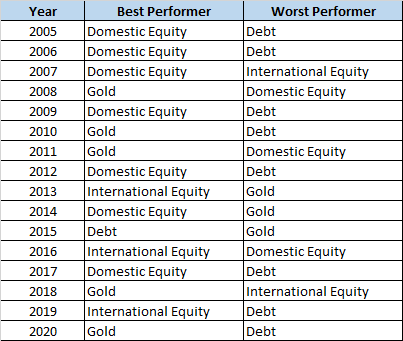
One very basic thing they forget that every asset class keeps on performing as per the rotation and nobody actually can predict which one is going to be the best or worst performer the next year or so.

You can see from the given below data table for various asset classes - Domestic Equity, Internation Equity, Gold & Bond, no one remain at the top consistently.


Last 15 years, you can clearly see there is a shift in the asset class performance.


The logic is simple, take some money out from the best-performing asset and infuse in worst performing and keep on rebalancing it every year.

Wednesday, December 9, 2020

Risk Profile Questionnaire

Attain all 10 MCQ to know your Risk Profililing:

A What would you consider "most important" with respect to your investments?
1 Low Risk with Low Returns
2 Moderate Risk with Moderate Returns
3 High Risk with High Returns

B You are on a TV show and can choose one of the following. Which one would you choose?
1 Rs. 10,000 in cash (guaranteed)
2 A 50% chance of winning Rs. 1 lac
3 A 10% chance of winning Rs. 10 lacs

C Your portfolio unexpectedly drops 30% in 3 months. What would you do?
1 Sell most of your holdings and stop your SIP
2 Do nothing - adopt a wait and watch strategy
3 Invest more in the market to take advantage of the reduced prices

D Your Financial Goals are predominantly
1 Short Term (< 3 years)
2 Medium Term (3 to 7 years)
3 Long Term (> 7 years)

E What is the first thought to cross your mind, when you invest your money?
1 I should not lose my money
2 This should not turn out to be a bad investment
3 I know this is a good decision

F How would you feel if the performance of your recent investments are below expectations
1 Very upset
2 Uneasy, but hope that it will improve in the future
3 Not upset because I know that all investments carry Risk

G Your personal investment objectives and financial goals are best described as:
1 Protect and preserve my capital
2 Produce a regular and stable income stream
3 Deliver high capital growth over longer-term are subject to high risk and volatility

H Your "cash need" is best described as:
1 My investments support my daily cash needs
2 I have regular income to support my daily cash needs, however, I appreciate the extra cash flow
3 My investment is for capital growth in the long term hence I don’t bother about interim payouts

I When you are looking for an instrument to invest in, what do you care about more?
1 Minimizing Losses
2 Both Equally
3 Maximizing Gains

J Please select the profile that best describes your willingness to accept losses on your portfolio
1 I am prepared to accept between 0% to 10% capital losses only
2 I am prepared to accept up to 20% capital losses only
3 I am willing to accept greater than 30% capital losses for the prospect of higher returns

Assign the score for each question as 1, 2, or 3 and aggregate to find out your final score.

Score Range

Investor Category

Risk

Debt %

Equity %

10-13

 Conservation

 Low

90%

10%

14-17

 Conservation to Medium

 Low to Medium

75%

25%

18-22

 Medium

 Balanced

50%

50%

23-27

 Medium to Aggressive

 Medium to High

25%

75%

28-30

 Aggressive

 High

10%

90%