Wednesday, December 9, 2020

Know your optimal level of Risk

Risk Profiling is a process of finding the Optimal Level of investment risk. It mitigates potential financial risk by understanding the Phycology of investors. Risk profiling provides tailor-made advice for every investor, as different investors possess a different risk tolerance level. 

Risk profiling is done through various Questionnaires and helps to determine a proper investment asset allocation for a portfolio.


Risk Capacity:
  • Risk Capacity is the level of financial risk, the investor can afford to take  
  • Ability to take risk relates to  Financial circumstances Investment goals  
  • The higher the level of wealth relative to liabilities, and the longer the investment horizon, then the greater the ability to take risk

Risk Tolerance:
  • Risk Tolerance is the level of risk, the investor is comfortable with  
  • Willingness or Risk Attitude relates to Psychometric assessment Framing & managing investors expectations  
  • If an investor has had a very low-risk tolerance (risk-averse) with a very demanding investment objective, something will have to give up

Risk Required:
  • It is the risk associated with the return required to achieve the investor’s goals with the available financial resources  
  • Evaluate an individual’s need to take the risk to achieve a goal  
  • A trade-off between Risk & Return


Factors influence the investor's risk profile:


Tuesday, December 8, 2020

What's your Money Personality

 ARE YOU READY FOR FINANCIAL SUCCESS?

 Take the below Quiz and Check your Financial Personality!


1.How much money do you want to have in five years?

a. Rs 100,000 to Rs 249,999.

b. Rs 250,000 to Rs 499,999.

c. Rs 500,000 to Rs 4,999,999.

d. Rs 5 million or more.


2. What is your financial dream?

a. Winning the lottery.

b. Getting a good job with health benefits, and three weeks’ vacation.

c. Owning my own home.

d. Having unlimited passive income from a business and/or real estate holdings or other investments.


3. Which statement best describes your financial situation?

a. I am very satisfied with where I am financially.

b. I am somewhat satisfied with where I am financially.

c. I am unsatisfied but feel hopeless. (maybe 'lazy' more so than 'hopeless')

d. My financial situation is completely unsatisfactory. I want much more.


4. How much time do you spend each day building your wealth?

a. Less than half an hour

b. Half an hour to one hour.

c. One hour to two hours.

d. Two hours or more.


5. How much money do you spend on business, financial education, and training?

a. Less than Rs 1000 per year.

b. Rs 1000 to Rs 4999 per year.

c. Rs 5000 to Rs 11999 per year.

d. More than Rs 12000 per year.


6. What do you do when you are faced with a difficult problem?

a. Ignore it and hope it will go away.

b. Complain to my friends and family.

c. Turn it over to someone else to worry about.

d. Brainstorm until I find a creative solution.


7. What is your attitude toward work?

a. It is drudgery. I hate my job.

b. I do not mind work, but I wish I were doing something else.

c. Work is okay. I have to work to get paid.

d. I love to work. It is exhilarating and fun.


8. What would you do if you lost your job or source of income?

a. Save money by moving in with friends or family and collect unemployment insurance.

b. Go back to school for retraining.

c. Find a new job.

d. Start my own company.


9. Which statement best describes your energy and concentration level?

a. I barely have enough energy to get through the day.

b. I work hard for a while, and then I run out of steam and coast through the rest of the day.

c. I can work hard for eight hours.

d. I am a blaze of energy, and I never get tired when I am doing something I enjoy.


10. Which best describes your reaction when someone tells you that you can't do something?

a. I give up and sit around feeling sorry for myself.

b. I lose my temper and throw a tantrum.

c. I give it another try.

d. I get energized, and will not give up until I get what I want.


11. You have an important decision to make and you do not know what to do. Which statement best describes your decision-making process?

a. I watch a lot of TV.

b. I talk to all my friends to see what they would do.

c. I analyze the situation logically and do what seems to make the most sense.

d. I trust my gut instincts after doing b and c.


12. What is your attitude toward people?

a. I believe people are generally good and would never lie, cheat, or steal from me.

b. I surround myself with people who look up to me, even if they are not the best qualified.

c. I hire the best people and trust them to do a good job.

d. I hire the best people and treat them professionally, but I watch them like a hawk.


13. When someone intentionally harms you or your reputation, how do you react?

a. I get very depressed and wonder why they do not like me.

b. I let it go. Why causes a stir?

c. I confront them and ask them why they did what they did.

d. I strike back, doing the same thing to them only ten times worse.


14. You are "on a roll" and everything seems to be going your way. What do you do now?

a. Take time off to go on vacation.

b. Maintain the status quo.

c. Start dabbling in another business or another career.

d. Stay involved and focused on my main business or career, driving it to new heights.


15. What is your attitude toward the business of being in a marriage?

a. My spouse and I love each other, and we would never get a divorce.

b. I believe my spouse loves me and even if we split, things would end amicably.

c. Divorce is a possibility. I do not want to think about it now.

d. I love my spouse and I do not want it to end, but I signed a prenuptial agreement to protect my finances in case it does.


How to find the Result?

Now, tally up your score. Count up the number of a's, b's, c's, and d's.


Give yourself:

1 point for every a

2 points for every b

3 points for every c

4 points for every d

15-25: Poor. You need a major attitude overhaul.

26-35: Average. You need to kick-start your attitude into high gear.

36-45: Good. You have potential but need to improve.

46-60: Excellent. You are ready for the big leagues. Let it rip!


Sunday, December 6, 2020

Its all about mindset - Rich People vs Poor People

You might be wondering why poor people remain poor generation after generation, struggle throughout their life for living hood. All comfort, luxury, lifestyle, and freedom being accessed to rich people only. Have you ever observed what basically rich people do differently which the poor usually fail to do so and remain in poverty?

It's all about Midset!

Let's see what Rich people do in their entire life:

  • Have multiple sources of income. Never ever depend on a single income source
  • Save first then spending, and whatever is saved, deploy it for investments to grow further
  • Focus on earnings
  • Know how to use debt for investing and take leverage benefit
  • Have more appreciating asset than a liability
  • Pay themself first - whatever comes, invest for their own future first
  • Know how compounding works in the longer term
  • Keep on upgrading themself
  • Invest in books, training, seminars, and personal development
  • Spend time creating new ideas or innovation
  • Have a clear & focused vision & mission in life
  • See opportunities and focus on reward
  • Laser-sharp focus on what is wanted -  solution-oriented
  • Learn to make money work for them
  • Fearless

And what Poor people do in their entire life:

  • Have only one source of income. Don't try to create multiple sources
  • Spend money first and save whatever is left, which usually not happens 
  • Focus on spending. Try to accumulate things for the household
  • Even don't afraid to use debt for spending 
  • Accumulate liabilities rather than assets
  • Pay other first... whatever earn  spend to make other people rich
  • Fail to calculate the compounding effect
  • Don't upgrade or change unless become mandatory
  • Don't invest in books, training, seminars, and personal development
  • Spend time watching TV and talking about people
  • Don't have financial foresightedness
  • See obstacles and focus on risk
  • Focus on what they don't want - full of complaints
  • Work hard for money for their entire life
  • Fearful
That is the reason, the majority of people never ever transformed from a poor mindset to a rich mindset in their entire lifetime.


The good part is that the mindset can be changed over a period of time from one another It's all about how you think about money and interacts with it. A rich mindset not only helps you to make more money, but you learn how to manage it in a better way. 

A rich person can have a poor mindset which leads to failure in the future, whereas a poor can have a rich mindset which leads a path to success eventually.

Saturday, December 5, 2020

Understand NEEDS vs WANTS

 In personal finance, it's very important to understand the difference between your NEEDS and your WANTS. Many people fail to distinguish the difference just like they don't understand what is an asset and what is a liability.

Therefore, because of the instant gratification and temptation, people end up buying the WANTS which eventually pull them down from their financial independence ladder. 

Always focus on your NEEDS first, and after saving (investing) enough for your future goals go on spending on WANTS whatever is left. 


To acquire Financial Freedom, you have to be very disciplined, consistent, and conviction in what you do. It's not an overnight process nor you get results in a short span of time. 

अगर आपका अपने पैसे पर नियंत्रण नहीं है… तो फिर और अधिक पैसा कमाने से कोई फायदा नहीं, कियोंकि पैसों के साथ साथ खर्चे भी बढ़ते रहेंगे ! 

सैलरी SIP में जानी चाहिये, EMI में नहीं !

Biases that can Lead to Blunders in Investments

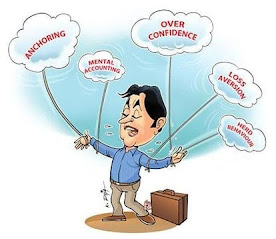
Biases are our belief or irrational thinking based on certain emotions or psychological barriers at our subconscious level that prevent us to make rational decisions for our investments, often leads to poor decisions or investment mistakes.


The most common biases are:

  • Anchoring Heuristic Bias: Refers to the human tendency to accept and rely on, the first piece of information received before making a decision.
  • Herd Mentality Bias: Refers to investors’ tendency to follow and copy what other investors are doing instead of using their own information or making an independent decision.
  • Availability Heuristic Bias: The human tendency to take a mental shortcut that relies on immediate examples that come readily to a given person's mind when evaluating a specific topic, concept, method, or decision.
  • Regret Aversion Bias: The tendency of investors to refuse to admit that a poor investment decision was made. On one hand, investors tend to avoid making decisions out of fear that the decisions will turn out poorly, or on another hand, it could be an impulsive purchasing during a limited-time offer and you fear that if you don't buy them now, you may never get an opportunity like this again.


  • Loss Aversion Bias: Refers to people’s preferences to avoid losing compared to gaining the equivalent amount.


  • Mental Accounting Bias:  The tendency of humans to develop and make decisions based on purely mental categories. Although they seem rational, the categories we create are often wholly arbitrary — and in some cases, dangerously misleading.


  • Status Quo Bias: When people preference for the current state of affairs by doing nothing or by sticking with a decision made previously. The current baseline is taken as a reference point, and any change from that baseline is perceived as a loss.


  • Confirmation Bias: This is the natural human tendency to seek information that confirms our existing hypothesis/understanding/view.
  • Trend Chasing Bias: Investors typically run after the past performance of an investment, thinking that historical return can predict the future performance of the investments. 


  • Familiarity Bias: An investor always has more appetite for familiar or well-known investments. This bias prevents the investor to explore and invest in better performing investments just because they are outside his or her comfort zone.
  • Self-attribution Bias: Attribute successful results to your own action but blame bad results to external factors.


  • Hindsight Bias: That allows people to convince themselves after an event that they had accurately predicted it before it happened. This can lead people to conclude that they can accurately predict other events.


  • Framing Bias: Occurs when people make a decision based on the way the information is presented, as opposed to just on the facts themselves. The same facts presented in two different ways can lead to people making different judgments or decisions.


  • Representative Bias: When making judgments about the probability of an outcome under uncertainty. People frequently make the mistake of believing that two similar things or events are more closely correlated than they actually are.


  • Optimism Bias: Causes someone to believe that they themselves are less likely to experience a negative event. 


  • Overconfidence Bias: A tendency to hold a false and misleading assessment of our skills, intellect, or talent. In short, it's an egotistical belief that we're better than we actually are.


Thursday, December 3, 2020

Behavior Finance

One of the greatest reasons why people fail to generate wealth is their own Behavior Finance. Even asset allocation stands at 2nd place. Behavior Finance is the psychology of investors that influences the result outcomes of investment done.

We human beings are not always rational and take decisions based on market movement, conditions, beliefs & biases. Our emotions are more volatile than those of the scheme or market where we have invested.

That is the reason, investor returns are always lesser than the scheme return. The investor can not put off their two powerful emotions of Greed & Fear. 

To overcome emotional decision i.e. behavior finance which is mainly driven by market sentiments, it is highly recommended attaching all investments with future financial goals.

Disclaimer: Investment in the securities are subject to Market Risk. 

Wednesday, December 2, 2020

Historical Return of Different Asset Classes

 Do you know what is the historical return of different asset classes? The mentioned table below indicates the average return since 1980 i.e. per annum return (CAGR) generated in the last 40 years by various asset classes. Equity scores the highest followed by Real Estate.


Imagine you had parked Rs. 1 lac with all asset classes in the year 1980. What value has been created by each asset class is also mentioned in the year 2020 considering their respective long-term per annum return. 


Needless to mention, a huge value generated by investing in Equity. No other asset class approaching even nearby. 

However, the million-dollar question is whether investors are able to cashout this phenomenon gains!

Not really, probably they don't understand how equity works in the longer term!


Disclaimer: Investment in the securities are subject to Market Risk. The past returns are not necessarily indicative of future returns.